
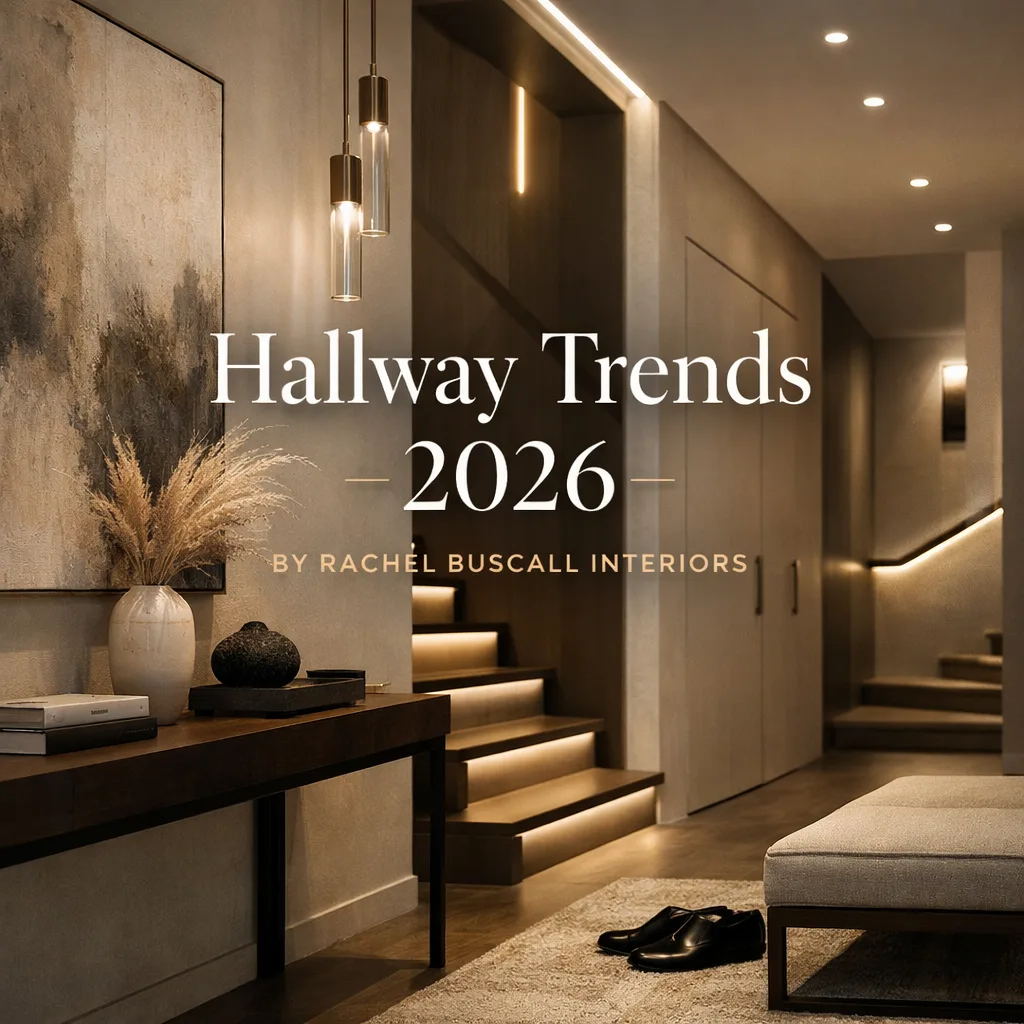
The hallway takes more punishment than any other room in the house and usually gets the smallest budget. Read this year's hallway trends as fixes for that and they start to make sense.
Good lighting does more for a hall than a new paint colour
Recessed ceiling channels, wall washes and discreet LED detailing in joinery or along the stairs are what designers keep reaching for, and it is easy to see why. A hall rarely has a window worth mentioning, so the light you add is the whole atmosphere. Wash a wall and the space looks wider. Light the stair edge and it feels safer at night.
The common mistake is a line of downlights down the middle, which gives you a runway. Put some light on the walls, add a lamp if there is a console, and fit a dimmer. The principles are in how to layer lighting in a luxury home.
Storage that disappears is the trend most worth copying
Full-height joinery with handleless doors in a tone close to the wall takes coats, shoes, bags and school kit out of sight in one go. A bench with drawers underneath, or shoe storage built into the seat, changes how the space works day to day. Calm in a hall comes from clear floor and clear walls, much as a clear desk does.
Measure what really lives there first. The pushchair, the muddy boots, the dog lead. Design the cupboard around that, not around an empty photograph. Fitted joinery is worth the money in exactly this kind of narrow, awkward space.
Textured finishes look good, but they have to survive scuffs
Limewash, clay paint, fluted panelling, microcement and warm timber are replacing flat painted walls, and they give a space with little else going for it some depth. They also meet bags, buggies and wet coats. Limewash and clay paints mark easily and are fiddly to touch up, fluted panelling holds dust in its grooves, and microcement needs a properly sealed finish.
None of that rules them out. Use the texture above waist height and put something tough below it, such as timber, tile or a wipeable painted panel.
Deep colour suits a hall, as long as it connects to the next room
Olive, moss, muted forest green, charcoal and ink are all working in halls. People pass through a hall rather than live in it, so you can go darker than you would dare in a bedroom, and a dark hall can make the rooms leading off it feel brighter by comparison. Choose with the next doorway in mind. Paint a large board, hold it where the hall is dimmest, and check it against the neighbouring room. The living room trends for 2026 show how deeper shades behave in the room most halls open into.
Borrow from hotel lobbies, then give the hall a job
The hotel influence is easy to spot. One good light, clean lines, one object worth looking at, nothing on the floor. One strong piece of art and some empty wall is enough, because the space around it is part of the design.
I'd borrow all that, with a purpose for the small things too. A dish for keys. A hook for the lead. A mirror for the last look before leaving. A hall that looks like a gallery but has nowhere to put the keys won't stay that way for a week.
Do the light and the storage first, and paint last
Paint is the cheapest thing to change, which is why it should come last. Get the lighting and the joinery right, choose finishes that will survive a first winter of wet coats, and only then settle the colour. Talk through your hallway with me if you would like that order planned for your house.