
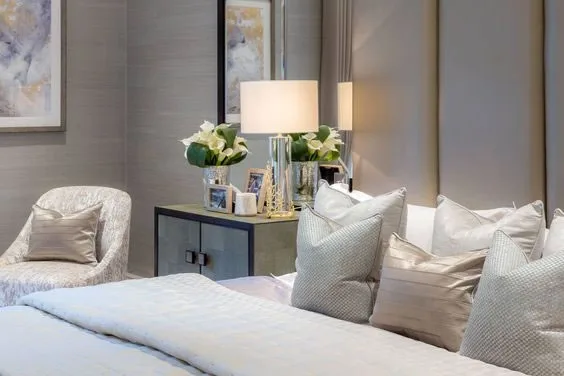
Most clients come to me with a clear picture of how they want their principal bedroom to look. Far fewer have thought about how they want it to feel at eleven o'clock at night, or at six the next morning. Yet the bedroom is the one room in the house judged almost entirely on how well you sleep in it, and a beautiful room that keeps you awake has failed at the only job that really matters.
The good news is that a restful bedroom and a luxurious one are not competing goals. The same decisions that make a room feel calm also tend to make it feel expensive.
Start With the Bed, Not the Furniture Catalogue
The bed is the reason the room exists, so I plan everything else around it. That means deciding its position before anything else: ideally on the wall facing the door, with a clear view of the entrance and without a window directly behind the headboard, where draughts and early light are hardest to control.
A generous upholstered headboard does more work than people expect. It anchors the room visually, softens the acoustics, and makes sitting up to read genuinely comfortable. A floor-to-ceiling panelled headboard, like the one in the room above, also adds height and a sense of tailoring that no amount of accessories can replicate.
Leave at least 70 centimetres of clear space on each side of the bed and at the foot. Squeezing in a larger bed at the expense of circulation space is one of the most common mistakes I see, and it makes even a large room feel cramped.
A Calm Colour Palette
Bedrooms are not the place for a palette that demands attention. Soft, layered neutrals, warm greys, mushroom, stone and muted greens, give the eye somewhere to rest. That does not mean the room has to be bland. Interest comes from tone-on-tone layering and texture rather than contrast: a grasscloth wallcovering, a silk-mix cushion, a nubby bouclé chair, a wool throw with real weight to it.
If you love colour, use it in deeper, quieter shades. An inky blue or forest green can be wonderfully cocooning in a bedroom, provided it is used across the whole room rather than on a single feature wall.
Light That Works With Your Body Clock
Light has more influence on sleep than almost any other design decision. Bedrooms need two things that pull in opposite directions: proper darkness at night and generous daylight in the morning.
- Window treatments should be layered, with blackout-lined curtains or blinds for sleep and a sheer for daytime privacy. Curtains that extend well beyond the window frame, hung close to the ceiling, block light leaks at the edges and make windows look larger
- Bedside lighting should be warm, low and independently switched on each side, so one person can read while the other sleeps
- Ambient light should be dimmable and kept below eye level in the evening, with no bright overhead downlights over the bed itself
I covered these principles in more detail in my guide on how to layer lighting in a luxury home, and the bedroom is where they matter most.
Texture, Fabric and Bedding
Luxury in a bedroom is something you feel before you see it. Invest in the surfaces your skin actually touches: good-quality cotton or linen bedding, a mattress chosen for your sleeping position rather than the showroom, and a rug underfoot on the side you get out of bed. Natural fibres breathe and regulate temperature far better than synthetics, which makes a real difference to sleep quality through the year.
Keep the cushion count sensible. A carefully chosen arrangement of three to five looks considered. Eleven looks like a hotel that has never had to make its own beds.
Storage Is What Keeps a Bedroom Calm
Visual clutter is the enemy of rest. The most serene bedrooms I design have more storage than their owners think they need, so that surfaces stay clear by default rather than through constant effort.
Fitted wardrobes that run floor to ceiling, ideally with handleless or discreet fronts, make a room feel quieter and more architectural. Bedside tables should have closed storage, a drawer or cupboard, so chargers, books and medication have somewhere to live out of sight. If space allows, a separate dressing area keeps the bedroom itself purely for rest.
Sound and Temperature
Two factors rarely appear on a mood board but have a major effect on how well a room works. Soft furnishings absorb sound, so a room with an upholstered headboard, full-length curtains and a large rug will feel noticeably quieter than one with hard floors and bare walls. For homes on busy roads, secondary glazing is one of the most worthwhile investments you can make.
Most people sleep best in a slightly cool room, around 16 to 18 degrees. Underfloor heating on a separate thermostat, or radiators with individual controls, lets the bedroom run cooler than the rest of the house without anyone having to think about it.
Keep Work Out of the Bedroom
Many of my clients run businesses, and the temptation to put a desk in the bedroom is strong. I always advise against it where there is any alternative. The bedroom works best when it has one clear purpose. If a desk is unavoidable, choose a design that can be closed or screened at the end of the day, so the room can switch off even when you find it hard to.
A Simple Test for Your Bedroom
Lie in bed with the lights off and look around. Can you see light leaking in from anywhere? Can you hear the street, the landing or the boiler? Is there anything in your eyeline that reminds you of an unfinished task? Each of those is a design problem with a design solution, and fixing them will do more for your sleep than any new accessory.
Start Your Project
If you're planning a bedroom redesign and want a space that looks beautiful and genuinely helps you rest, I'd be glad to talk it through. Get in touch to arrange an initial conversation.
Rachel Buscall Interiors
Where Business Excellence Meets Design Innovation